my favorite saint is Clare of Assisi because she is A) the patron saint of television, B) my name saint, C) a motherfucking boss who wanted to join St. Francis of Assisi’s band of like wandering homeless bro-dudes for Christ and Francis was like “sure!” and the Catholic Church was like “but you’re a LADY” and she was like “fuck you, you think ladies can’t sleep on the ground and eat tree bark as well as these asshats, LET ME FUCKING EXPLAIN TO YOU HOW POVERTY WORKS”, oh btw i should explain that Clare came from a family that was RICH AS HELL and so did Francis so like please give them props for voluntarily giving up their comfy beds and nice clothes because they were like “it’s shitty to think that you’re helping the poor by just tossing gold coins at them from inside your MOTHERFUCKING CASTLE”
So ANYWAY
the religious orders for nuns at the time were like pretty cool in some ways because if you were a lady who didn’t want to get married and have a jillion babies you could be like “SORRY BOYS, GOD’S CALLIN’, GOTTA GO JOIN A BENEDICTINE CONVENT, DON’T LET THE DOOR HIT YOUR ASS ON THE WAY OUT” and then spend the rest of your life chilling with ladies and doing needlework and reading fucktons of books and being better educated than 99% of the best-educated men in the upper classes, but that was largely a privilege for rich ladies, so in a lot of ways it wasn’t really all that big of a social change? like abbots and abbesses were still in the upper strata of society? but what francis and his dudebros did was like revolutionary at the time, like “WE SHALL OWN NO PROPERTY AND EAT WHATEVER COMES OUR WAY AND WHATEVER WE HAVE WE GIVE TO THE POOR FIRST AND WE’LL LIVE IN THE WOODS IF WE HAVE TO, WHATEVER, IT’S ITALY, THE WEATHER’S USUALLY PRETTY CHILL, BUT MOST OF ALL WE WON’T HAVE TO GIVE ANY FUCKS ABOUT BUREAUCRACY OR THE POLITICAL ELITE B/C WE’RE GETTING BACK TO NATURE, DUDES”! like it was this lowkey Robin Hood plus 1970′s hippie commune plus socialism plus Twelve Apostles cosplay plus the biggest middle finger imaginable to their mortified rich parents (”girl was that your son Francis singing hymns to Brother Moon in the town square while dressed in rags” “GIRL I DON’T WANT TO TALK ABOUT IT, PASS THE CHARDONNAY”). and that’s all like super rad! and even though it started with dudes because it was just ol’ Frank and his bros, they were all for having the ladies come hang!
BUT WAIT
because in order to have their way of life legitimized which was super important to Francis – he didn’t want to just be a ragtag bunch of weirdos, he wanted this to be a religious movement that would spread through Europe and hopefully revolutionize a CORRUPT AF institutional church bureaucracy – he had to get the Pope’s approval to make them a religious order. Which he super did, no problem. So then Clare trots over to Rome and she’s like “yeah so I’m gonna need that same piece of paper you gave my BFF Francis” and they’re like “TAKE YOUR VAGINA AND YOUR FRAGILE SILKY WHITE GIRL-SKIN AND YOUR WEAK LITTLE LADY BOD BACK TO ASSISI, SWEETHEART, LEAVE THE SLEEPING-IN-THE-WOODS SHIT TO REAL MEN” and they wouldn’t legitimize her religious order (which was already like a major posse by this point) because there were zero religious orders at that time for women which required a vow of poverty.- though there were already LOTS for dudes, not just the Franciscans – because they thought the girls couldn’t hack it.
“BITCH PLEASE”
So Clare (who by the way a lot of Catholics treat like she was just Francis’ junior partner but SHE OUTLIVED THAT MOTHERFUCKER BY THIRTY-SEVEN YEARS, so she’s LITERALLY the reason his ideals and his legend spread as far as they did, because she was running the fucking show) basically made it her life’s work to pester an endless succession of Popes, one after another, into granting a poverty dispensation to the Poor Clares. They weren’t waiting on permission to like DO THEIR SHIT, mind you – Clare kept doing Clare, living with her ladies in the convent Francis LITERALLY BUILT FOR HER WITH HIS OWN TWO HANDS WHICH IS ROMANTIC AF, I’M SURE THEY WERE GOOD CELIBATES AND DIDN’T BANG BUT YOU CAN’T TELL ME THEY WERE NOT TOTALLY IN LOVE, I SHIP IT LIKE FEDEX, and engaging in the same radical practices as the Franciscans of living in actual community with the poor. Not just like throwing a few bucks in the collection plate on Sunday and patting themselves on the back for what good Christians they were, but throwing their doors open so that anyone in Assisi who was hungry or homeless could be welcomed without judgement as their brothers and sisters. So FINALLY after ACTUAL DECADES like the fifth or sixth Pope in a row that she screamed at was like “OH MY GODDDDDDD, FIIIIINE, take your poverty dispensation and FIND A NEW HOBBY BESIDES YELLING AT POPES EVERY TEN GODDAMN SECONDS,” and that’s how Clare of Assisi struck a blow for feminism in the 1100′s by convincing the Catholic Church that women’s bodies were not fundamentally weaker than men’s.
OH ALSO
THIS FUCKING HAPPENED
”In 1224, the army of Frederick II came to plunder Assisi. Clare went out to meet them with the Blessed Sacrament in her hands. Suddenly a mysterious terror seized the enemies, who fled without harming anybody in the city” (x)
SO SHE’S ALSO LIKE A VALKYRIE BASICALLY
Plus when she was old and too sick to go down to the chapel for Mass, she had visions where she could watch what was happening on the wall of her bedroom, so she could still participate, AND THAT’S WHY SHE’S THE PATRON SAINT OF TELEVISION
IN CONCLUSION, Clare of Assisi was a mouthy feminist badass who bitch-slapped the societal expectations of her mother, her zillionaire family, her entire social caste, all of Assisi basically, like seriously half a dozen Popes, all of institutional Catholicism, and pretty much like THE WORLD to give up her inheritance, cut off all her hair, and go run away with her best friend to go build a hippie commune in the woods based around the radical notion that poor people are actual human beings.
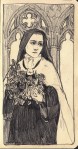
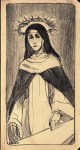
St Teresa (Teresa de Cepeda y Ahumada) was born in Avila, Spain on 28th March 1515. Her parents were both pious Catholics and in some ways inspired their daughter to take up a life of prayer. As a young child, Teresa showed signs of a deeply religious nature; she would often retreat into silence for prayer and would enjoy giving alms to the poor. She was very close to her mother, who provided a warm counterbalance to the strictness of her father. However, in her teens, Teresa’s mother passed away, leaving the young Teresa distraught at the void she felt. The young St Teresa tells of her despair and how she turned instinctively to the Virgin Mary for comfort.
“I threw myself down in despair before an image of the Mother of God. With many tears, I implored the Holy Virgin to become my mother now. Uttered with the simplicity of a child, this prayer was heard. From that hour on, I never prayed to the Virgin in vain.”
During her later teen years Avila lost some of her early piety and religious zeal. She recounted how she became interested in worldly matters and enjoyed the company of a wide circle of friends. She had a natural charm and found it easy to make friends. In return, she enjoyed the compliments and friendships of others. However, she was not at peace, considering herself to be a miserable sinner; later she would look back in guilt at her early life. However this sense of being a “miserable sinner” was probably the result of a harsh self-judgement, encouraged by her father’s exacting religious standards. At the age of 16, her father decided to send Teresa to a convent school to be educated.
This reignited in Teresa an interest in following a spiritual life and after some deliberation resolved to become a nun of the Carmelite Order. At the time the convent rules were not very strict; it was probably more relaxed than living with her father. The convent accepted many people into the order, often for financial reasons. The convent became overcrowded, and people were often judged not by spiritual intensity but on material possessions. In this climate, Teresa struggled to find time for quiet reflection, although she did start teaching people on the virtues of mental prayer.
Shortly after becoming a nun, Teresa experienced a severe illness (malaria), which left her in great pain for a long period. At one point it was feared that her illness was so severe that she would not be able to recover. However, during this period of intense physical pain, she began to increasingly experience divine visions and an inner sense of peace. These inner experiences of joy and peace seemed to transcend the intense physical pain of the body. She describes in her own words her state of mind during these trials and tribulations:
“I bore these sufferings with great composure, in fact with joy, except at first when the pain was too severe. What followed seemed to hurt less. I was completely surrendered to the will of God even if he intended to burden me like this forever… The other sisters wondered at my God-given patience. Without Him I truly could not have borne so much with so much joy.”
When she was a little better, she resumed her prayers with renewed vigour. However, after telling others of her visions and spiritual experiences, she was dissuaded from pursuing them. Certain clergy felt they were delusions of the devil. As a result, for many years Teresa lost the confidence to practise her prayers, and her spiritual life was almost put on hold. However, when Teresa was 41, she met a priest who convinced her to go back to her prayers and implore God to come back. Initially, she had some difficulty sitting through prayers. She wryly remarked the end of the hour’s prayer couldn’t come soon enough. However, in the course of time, she became absorbed in deep contemplation in which she felt an ever-growing sense of oneness with God. At times she felt overwhelmed with divine love. The experiences were so transforming, she at times felt the illumining grace of God would wash her soul away. She was so filled with divine contemplation it is said at times her body would spontaneously levitate. Teresa, however, was not keen on these public displays of ‘miracles’. When she felt it happening she would ask other nuns to sit on her to prevent her floating away.
Teresa was not a just a quiet, placid saint. She had an endearing, natural quality; her life energy attracted and inspired many who were close. They admired her for both her outer charm and inner serenity. But at the same time, her religious ecstasies also caused jealousy and suspicion. Unfortunately, she was born into the period of the Spanish Inquisition, during this time any deviation from the orthodox religious experience came under strict observation and scrutiny. On one occasion Teresa complained to God about her mistreatment from so many different people. God replied to her saying “That is how I always treat my friends.” With good humour, St Teresa replied, “That must be why You have so few friends!” St Teresa struggled because there were few who could understand or appreciate her inner ecstasies. However, on the one hand, she felt these experiences to be more real than ordinary events.
At the age of 43, St Teresa decided she wanted to found a new order recommitting to the values of poverty and simplicity. She wanted to move away from her present convent which made a life of prayer more difficult. Initially, her aims were greeted with widespread opposition from within the town of Avila. However, with the support of some priests, the opposition waned, and she was allowed to set up her first convent. St Teresa proved to be an influential leader and founder. She guided the nuns not just through strict disciplines, but also through the power of love, and common sense. Her way was not the way of rigid asceticism and self-denial. Although she underwent many tribulations herself, to others, she stressed the importance of experiencing God’s Love. As she herself says:
“You know, I no longer govern in the way I used to. Love does everything. I am not sure if that is because no one gives me cause to reprove her, or because I have discovered that things go better in that way.”
“The important thing is not to think much but to love much and so do that which best stirs you to love. Love is not great delight but desire to please God in everything.”
St Teresa devoted much of the rest of her life to travelling around Spain setting up new convents based on the ancient monastic traditions. Her travels and work were not always greeted with enthusiasm; many resented her reforms and the implied criticism of existing religious orders. She often met with criticism including the Papal Nuncio who used the rather descriptive phrase “a restless disobedient gadabout who has gone about teaching as though she were a professor.” St Teresa also had to frequently contend with difficult living conditions and her frail health. However, she never let these obstacles dissuade her from her life’s task. She eventually died on October 4 at the age of 67. A fellow sister describes the hours just before the death of St Teresa:
“She remained in this position in prayer full of deep peace and great repose. Occasionally she gave some outward sign of surprise or amazement. But everything proceeded in great repose. It seemed as if she were hearing a voice which she answered. Her facial expression was so wondrously changed that it looked like a celestial body to us. Thus immersed in prayer, happy and smiling, she went out of this world into eternal life.”
Let us pray,
O God, by your Holy Spirit you moved Teresa of Avila to manifest to your Church the way of perfection: Grant us, we pray, to be nourished by her excellent teaching, and enkindle within us a keen and unquenchable longing for true holiness; through Jesus Christ, the joy of loving hearts, who with you and the Holy Spirit lives and reigns, one God, for ever and ever. Amen
so I’ve always sort of liked the idea that within the communion of saints there the Heavy Hitters, the Career Saints who are invoked widely and in situations of grave need—I’m talking your Catherines and Francises and Theresas, the Twelve Disciples and Michael; the Big Time Major League saints who intercede on behalf of so many, and so are always in conversation with the divine, case managers for the sick and dying and hurting and faithful of the world.
but that also means that there’s a bunch of saints hanging around who are just—minor holy women, lesser martyrs, incidental virgins, doctors of the church who never managed to find a publisher. They’re not prayed to very often, and rarely called on to manage the difficult cases; they have a lot of free time.
so what do you do, if you’re a saint with some free time on your hands? You answer all the not-quite-prayers, the “jesus, don’t turn red don’t turn red’ muttered by cab drivers and the “christ, can you just try it to see this from my point of view?” spat out by a furious girlfriend and all the “oh god please let me make this meeting in time” “please don’t let me fail” “I’m so tired I hope I can get home”
or maybe I just like the idea that every time you mutter “god, let me be okay” there’s some girl killed in 9th century for refusing to marry who falls into step beside you—and though no book or chronicle or living person remembers her name, she squints up at you and says with holy authority, “yeah, you’re going to be fine.”
The earliest known book-length biography of an African woman, a 17th-century text detailing the life of the Ethiopian saint Walatta Petros, has been translated into English for the first time.
Walatta Petros was an Ethiopian religious leader who lived from 1592 to 1642. A noblewoman, she left her husband to lead the struggle against the Jesuits’ mission to convert Ethiopian Christians to Roman Catholicism. It was for this that the Ethiopian Orthodox Täwaḥədo Church elevated her to sainthood.
Walatta Petros’s story was written by her disciples in the Gəˁəz language in 1672, after her death. Translator and editor Wendy Laura Belcher, an associate professor at Princeton University, came across the biography while she was studying Samuel Johnson’s translation, A Voyage to Abyssinia. “I saw that Johnson was fascinated by the powerful noble Ethiopian women in the text,” said Belcher. “I was speaking with an Ethiopian priest about this admiration and he told me that the women were admired in Ethiopia as well, where some of them had become saints in the Ethiopian church and had had hagiographies written about them.”
Ten years later, Belcher still remembers how “thrilling” this revelation was. “What? Biographies of powerful African women written by Africans in an African language? And to be able to pair European and African texts about the same encounter? I knew then I wouldn’t rest until I had translated this priceless work into English.”
Belcher learned Gəˁəz in order to translate Walatta Petros’s biography, working first with the Ethiopian priest, and then with the translator Michael Kleiner. “As a biography, it is full of human interest, being an extraordinary account of early modern African women’s lives — full of vivid dialogue, heartbreak, and triumph. For many, it will be the first time they can learn about a pre-colonial African woman on her own terms,” she said.
The biography has now been published in English by Princeton University Press as The Life and Struggles of Our Mother Walatta Petros. It has only been translated into two other languages before: Amharic and Italian, the latter in the 1970s.
While researching the text, Belcher discovered that the biography contained the earliest known depiction of same-sex desire among women in sub-Saharan Africa, an element she said was “censored” from the manuscript that the 1970s Italian edition was based on.
Belcher writes in the book’s preface that while she and Kleiner were translating the story from the Italian edition, they came across a “perplexing anecdote about a number of community members dying because some nuns had pushed each other around”. Kleiner suspected the manuscript had “been miscopied, perhaps deliberately, in order to censor the original, or merely by accident”, and speculated that “the nuns were not fighting but flirting with each other”.
After consulting with several Ethiopian scholars and looking at digitised copies of the original manuscripts, Kleiner and Belcher found the uncensored manuscript concurred. They translated the line as Petros seeing “some young nuns pressing against each other and being lustful with each other, each with a female companion.”
“This is the earliest anecdote we know of in which African women express desire for other women,” writes Belcher.
The academic also pointed to Walatta Petros’s relationship with her fellow nun Eheta Kristos, describing their first encounter with each other as “rapturous”. The text says that “love was infused into both their hearts, love for one another, and… they were like people who had known each other” their whole lives. Walatta Petros and Kristos “lived together in mutual love, like soul and body. From that day onward the two did not separate, neither in times of tribulation and persecution, nor in those of tranquillity, but only in death”.
“There is no doubt that the two women were involved in a lifelong partnership of deep, romantic friendship,” Belcher writes.
Identifying them as lesbians would be “anachronistic” partly because Walatta Petros was “deeply committed to celibacy”, she told the Guardian.
“Many Ethiopians are quite upset about my comments about the saint, my interpretations of her relationship with Eheta Kristos,” she said. “Part of this upset is due to not understanding my point. I think she was a sincere, celibate nun, but that she also felt desire for other women and that she was in a life-long celibate partnership with Eheta Kristos.”
I just kept smiling wider and wider the more I read.
You, O Eternal Trinity,
are a deep sea into which,
the more I enter,
the more I find,
and the more I find,
the more I seek.
O abyss,
O eternal Godhead,
O sea profound,
what more could you give me than yourself?
God’s grace, unsought and unearned,
blows through my life,
and all I need to do
is raise my sails to catch the full wind.






 bennu rising