jesus is ultimately born from the vastness of need: need for justice, need for freedom, need for equality.
he stood in front of the crowds of well-off, profit-worshiping privileged, told them that a camel will never walk through the eye of a needle no matter how much money they funneled into that endeavor, and then he strode right through that crowd of open-mouthed men to stand on the other side, with the poor, the hungry, the ill, the disabled, the exiled, the oppressed, the imprisoned, the enslaved, the sex workers, and the sinners too. his message stripped bare was this: that the people in power were wrong for treating you like you were less than them, and that the corrupt state they enacted should be dismantled until nothing remains but the ashes from which retribution shall spring.
turning the other cheek? explicitly a command for servants to get their masters to treat them like equals, because lessers were hit with the back of the hand and equals were hit with an open palm. go two miles when you were only asked to walk one? roman law said a jew could be required to carry a soldier’s pack for one mile but one mile only, so volunteering to carry it for another meant you were showing the soldier that you could have power over him.
jesus took one look at the corruption and injustices of capitalism and overturned both the literal and the proverbial table. we think of jesus as an emblem of kindness, and he was that, transfiguring fish into loaves of bread, healing the incurable, blessing the unclean, laughing at jokes, tearing up at sunsets, singing singing singing about grace. but jesus was also a man of color executed by the police force of the day for challenging the patriarchal capitalist structures erected by the state.
‘love your neighbor as yourself’ is unquestionably a socialist teaching. what is more radical than saying that everyone is worthy of god? because everyone means the marginalized, everyone means women, means people of color, and lgbt people, and anyone who’s ever been considered worth less to society because you’re not a rich cishet able-bodied white man. god isn’t for them. they already have all the power and control they could ask for; they don’t need god. god is for us, we who were told we’d never be strong enough to survive, we who sweat at rallies and bleed at riots, we who dance unashamed of our bodies and love unashamed of our hearts.
two thousand years ago the fires of every star got condensed into one man, and that man came to earth as an infant carried in the body of a poor teenage brown girl. he grew up among us and lived our lives so that he could courageously declare that we don’t deserve to be called inferior. and i’ll be damned if i’m going to let anyone try to take that away from me
I think it’s one of the moments in the gospels where Jesus is the most vulnerable and powerless. Like, he’s terrified. He’s literally interceding with God one last time to spare him from the horrors to come even though he knows he has to go through with it. He knows there’s no way out, at least in most interpretations. And he asks his closest friends to stay awake with him and watch for the man who is coming to betray him and the men who are coming to humiliate, torture, and kill him. And they fall asleep multiple times. Brutal. Of course they’re reconciled to Jesus after the resurrection; Jesus forgives the disciples and cooks breakfast with them and laughs with them and teaches them but man. Gethsemane was not a shining moment for Jesus’ friends.
If I was going to preach on this text I would say it highlights how we all fall asleep on God a lot. We aren’t capable or being what God needs/wants us to be all the times, and sometimes we don’t even try to be. And seeing that played out through the incarnation, where Divinity experiences the limitations, pangs, and fears of flesh makes meaningful relationships with individual humans is sobering. It’s also one of the many moments in the gospels where we see Jesus praying and I think prayer is something a lot of Christians don’t understand or have trouble doing, so it reminds us that prayer is always a good thing. God is with us even in the Gethsemanes of our lives, when the sun wont be rising for a long, bloody night yet.
we have no sign of how christ treated his betrayer on a daily basis, you know. we do know he was trusted with money, and that they had no idea it would be him. when it was said that one of their number would betray their lord, not one of them nodded sagely and said “i knew it, it’s judas.” not one of them.
how easy it would have been for him to put distance there, to just step away, to lessen the pain and the sting every time judas looked at him. but no. no, not christ. it was always, always, always love.
there is constant agony over the knowledge that jesus CHOSE him. a crowd, a following, all of israel to chose to be one of his closest friends, and jesus looked at the multitude and met the eyes of the one with a greedy heart and jealous mind and he said “that one.” he looked at his betrayer, the one who would commit the Sin of Sins, and he smiled and he said “father, give him to me.”
“let him be mine.”
“i choose death. i choose pain. i choose to let this one know my heart before he breaks it.”
he could have been delivered up another way. someone else could have told the priests — someone could have seen the group and known and ran to earn payment. someone who was unaffiliated, whom they wouldn’t have known and been so hurt by.
but no. no, jesus looked at him and loved him.
god made the job harder in no physical manner, only with love. and so no one has ever, i think, broken the lord’s heart so thoroughly as judas. because he let the serpent into the nest and made it comfortable, walked toward the hungry lion with welcoming arms.
in the end, it was also the story of us, betraying him who we had no reason to betray, and suffering the burden for it when we refused his grace. our redemption in the arms of him whom we worst offended. “while we were yet sinners”
judas is the story of grace overflowing, cascading, washing over us all. jesus pulled him into dances, had inside jokes, sat next to him at meals, ruffled his hair in the mornings, winked at him during sermons. judas was no outcast — he was in jesus’ close circle, his family. jesus stayed up late sometimes with him and talked about stars while the other disciples slept around the fire. they had dialogue about old testament verses and their meaning, swapped stories of their childhoods, kissed each others’ mothers on the cheek. judas heard his sermons and likely had comments, questions, ideas, adorations. (because jesus chose to lead him but judas chose to follow) they were blood brothers, until judas shed jesus’ blood, sold his brother for silver, did not listen when all the earth cried out. (all creation, all eternity building to this climax) (cain and abel) (joseph and judah) (yeshua and judas) (we’ve heard this before, we know how it ends don’t we, god bring the plot twist or avert our eyes)
most powerful of all, when christ washed his feet. kneeling, wrapped in a towel, and silently, gently, lovingly he lifting the feet of his betrayer to intimately clean them.
“i knew it, it was judas” never came from any of their mouths, not even from the mouth of he who knew. instead he smiled, and the kiss was only expected. “i knew it, it was judas” “father let him be mine”
I think she loved the tousle-haired Rabbi Yeshua, this man from nowhere Judea with the dark eyes and the easy smile, who stood outside the city gates and preached to crowds. I think she loved the prophet who was also divine, the Son of God who got pebbles in his sandals while walking and had to lean on Peter’s shoulder to scrape them out. He could walk into the marketplace and draw every eye, open his mouth and speak words that burned the air, but he also told terrible jokes that made Judas scoff and pelt him with olives.
But in love? No. I think Mary Magdalene loved Jesus the way all the other disciples loved him—in a way that was platonic and difficult to describe; it was a love that made all other loves seem—not worse, but narrower, a
little myopic. As though they were missing a piece, falling short of some whole they could only glimpse, and only around him.
Later, after everything, they’ll try to talk about it among themselves. But the words won’t come, won’t sit right, and they keep circling back to, it was like a dream, like being wine-drunk and warm for three yearsand then waking up the next morning cold, it was something, we’re not sure what but
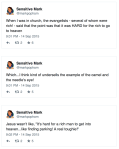
A late night interpretation of Jesus’ thoughts about rich people by Sensitive Mark.
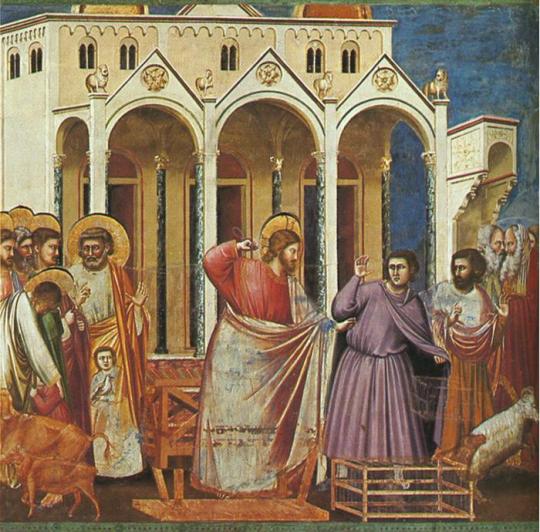
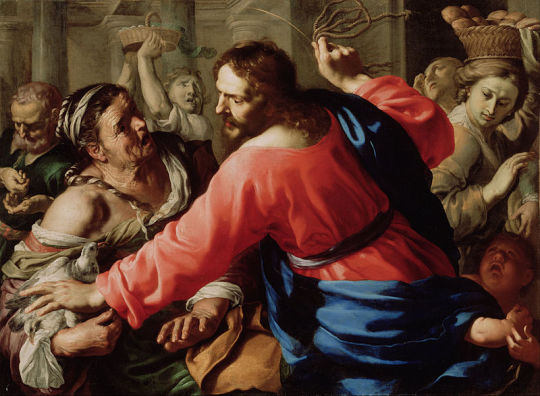
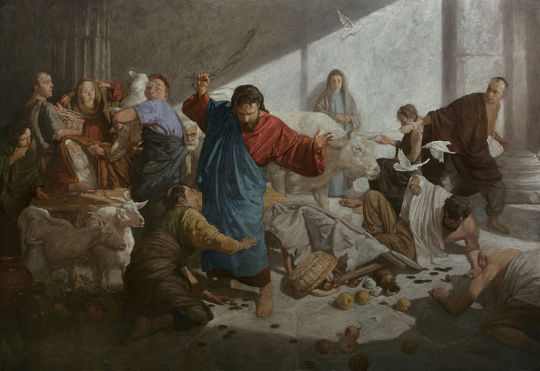
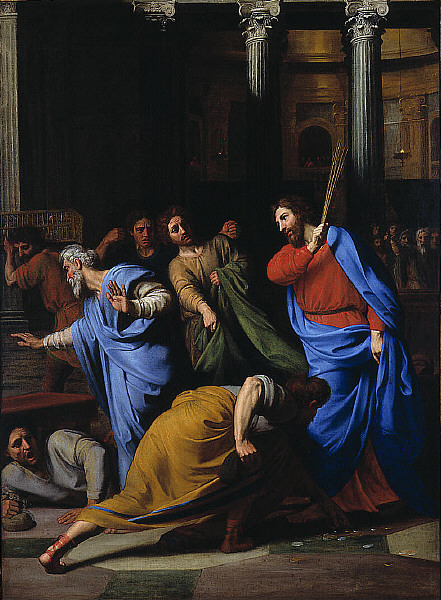
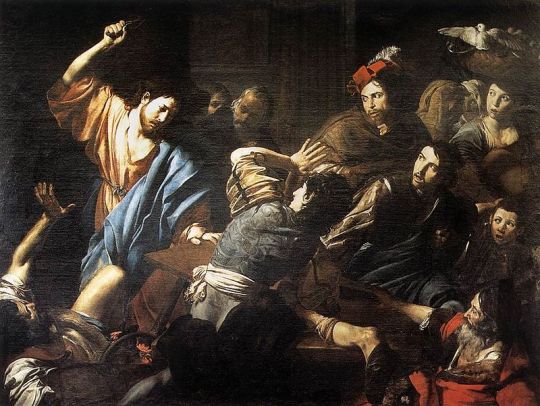
While we’re at it, don’t forget that one time that Jesus saw predatory lending practices going down in the temple and he actually got violent.
Yes. Jesus got violent. Over predatory lending practices.
Throwing tables and threatening people with a whip. Jesus was super pissed.
And that part is consistent across all four of the Gospels. Mathew, Mark, Luke, and John vary in a lot of places, but they’re consistent on the money changers story.
Also, the paintings that this inspired are pretty rad.
99% of the time, Jesus was all “love thy neighbor” and “turn the other cheek” and “if someone asks you to walk a mile with them, walk two,” but where usury was concerned, he’d straight up kick your ass.
Jesus: “Be chill. We should all be chill. But also don’t lend money to people and charge them ridiculously high interest rates. Don’t do that. Especially not when people borrow money for the purpose of doing the right thing and making themselves better people. I really fucking hate that. Seriously, just don’t.”
*smashcut to 2016*
Me, living in a society that is intrinsically founded upon Christian doctrine and beliefs: “Student loan debt and credit card interest rates, am I right?”









 bennu rising