Emma Maayan-Fanar was looking for shade from the desert sun when she saw the face of Jesus.
The art historian from the University of Haifa in Israel had been studying crucifixes and other motifs on the stone lintels of the ancient churches and houses of the ruined city of Shivta in the Negev Desert.
Although it was February, days in the desert can still get hot — and so Maayan-Fanar found some shade under one of the few pieces of roof still intact at the site, in the baptistery of the northernmost of three ruined churches in the ancient city.
That’s when she saw eyes looking out from the stones — the very faint remains of a portrait of Jesus Christ at his baptism in the Jordan River, painted on the ceiling of the building around 1,500 years ago. Read more.
Its funny that as gay Christians we have to go through gymnastics to try to prove that God loves and accepts us, that our love is blessed and our bodies uncursed, when if you go back to the Didache and other Christian writings from the earliest, apostolic age, you find a lot of condemnations of things like magic and astrology but nothing against gay love. Yet no modern, conservative Christians are lobbying their local paper to remove the horoscopes!!
“Well such sinful lifestyles were unknown in those times, or at most very uncommon” dude this was the first century eastern Mediterranean. People wrote so much gay love poetry in this time period that enough survived for us to fill books with today, and the words to describe gay men and lesbians were widely known and available. And yet! And yet none of these words were used to describe sin!!
Early Christians hated magic and astrology because they asserted that God and nothing else has the final say on matters of nature and fate, and had to compete with other ways of understanding the world and its meaning. They were not spending any time antagonizing gay people.
That practice has its roots much later, in the late 4th century context, when the church was 300 years removed from the ministry of Christ and had become a Roman state institution rather than a persecuted underground community of believers. By this period of antiquity the Greco-Roman obsession with masculinity had morphed from the cocksure posture of previous more prosperous years, where sexual assault was valorized as a sign of virility and strength (Im not a big fan of greco-roman culture tbh), to the tropes more common of a time when authority is in crisis, when all the powerful men become fixated on preserving their power by 1) not cumming and 2) beating homosexuals – sound familiar?
In that context, the later church fathers who were beholden to temporal power structures and educated by these customs authored the first condemnations of homosexuality in Christian doctrine, and not without some controversy.
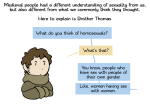
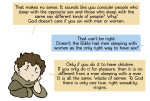
Spiritual authorities based farther away fron the centers of power in Rome and Constantinople remained ambivalent toward homosexuality, and when the Roman empire collapsed and the middle ages began there was a period of general permissiveness toward gays including the inauguration of “brother-making” and “sister-making” ceremonies that bonded two people of the same sex together for life and allowed them to jointly own property and raise children. This ended with the renaissance, however, and the gradual return of (late) greco-roman law and philosophy prompted a return to the old condemnation of homosexuality.
As a medieval scholar I can confirm this us 100% accurate and 1000% adorable
More information about Medieval European sexuality can be found in Karras’ thesis, Berkowitz, and Boswell. This link has a collection of works about non-heteronormality in Medieval Europe.
It’s always important to remember that current sexual politics have not gone through a straight line of evolution from point A to point B. Even within the limited confines of Europe alone, sexual politics have never meant one thing to all living society. And that’s not even getting into the rest of the world and how they evolved, and how all that affects life today.
And just fyi; this comic, while cute and extensive, has a lot of holes and misinformation like most of Humon’s work on sexuality. A man who masturbates to the thought of a woman can very well be gay. Sex between two women can involve penises. Asexuality isn’t defined by ‘people who don’t want to have sex’, and a chaste marriage doesn’t automatically equate to an asexual relationship. Sexual orientations and identities are defined by sexual feelings, not libido or drive. Being aroused by explicit imagery is different from actually being attracted to a specific someone.
The earliest known book-length biography of an African woman, a 17th-century text detailing the life of the Ethiopian saint Walatta Petros, has been translated into English for the first time.
Walatta Petros was an Ethiopian religious leader who lived from 1592 to 1642. A noblewoman, she left her husband to lead the struggle against the Jesuits’ mission to convert Ethiopian Christians to Roman Catholicism. It was for this that the Ethiopian Orthodox Täwaḥədo Church elevated her to sainthood.
Walatta Petros’s story was written by her disciples in the Gəˁəz language in 1672, after her death. Translator and editor Wendy Laura Belcher, an associate professor at Princeton University, came across the biography while she was studying Samuel Johnson’s translation, A Voyage to Abyssinia. “I saw that Johnson was fascinated by the powerful noble Ethiopian women in the text,” said Belcher. “I was speaking with an Ethiopian priest about this admiration and he told me that the women were admired in Ethiopia as well, where some of them had become saints in the Ethiopian church and had had hagiographies written about them.”
Ten years later, Belcher still remembers how “thrilling” this revelation was. “What? Biographies of powerful African women written by Africans in an African language? And to be able to pair European and African texts about the same encounter? I knew then I wouldn’t rest until I had translated this priceless work into English.”
Belcher learned Gəˁəz in order to translate Walatta Petros’s biography, working first with the Ethiopian priest, and then with the translator Michael Kleiner. “As a biography, it is full of human interest, being an extraordinary account of early modern African women’s lives — full of vivid dialogue, heartbreak, and triumph. For many, it will be the first time they can learn about a pre-colonial African woman on her own terms,” she said.
The biography has now been published in English by Princeton University Press as The Life and Struggles of Our Mother Walatta Petros. It has only been translated into two other languages before: Amharic and Italian, the latter in the 1970s.
While researching the text, Belcher discovered that the biography contained the earliest known depiction of same-sex desire among women in sub-Saharan Africa, an element she said was “censored” from the manuscript that the 1970s Italian edition was based on.
Belcher writes in the book’s preface that while she and Kleiner were translating the story from the Italian edition, they came across a “perplexing anecdote about a number of community members dying because some nuns had pushed each other around”. Kleiner suspected the manuscript had “been miscopied, perhaps deliberately, in order to censor the original, or merely by accident”, and speculated that “the nuns were not fighting but flirting with each other”.
After consulting with several Ethiopian scholars and looking at digitised copies of the original manuscripts, Kleiner and Belcher found the uncensored manuscript concurred. They translated the line as Petros seeing “some young nuns pressing against each other and being lustful with each other, each with a female companion.”
“This is the earliest anecdote we know of in which African women express desire for other women,” writes Belcher.
The academic also pointed to Walatta Petros’s relationship with her fellow nun Eheta Kristos, describing their first encounter with each other as “rapturous”. The text says that “love was infused into both their hearts, love for one another, and… they were like people who had known each other” their whole lives. Walatta Petros and Kristos “lived together in mutual love, like soul and body. From that day onward the two did not separate, neither in times of tribulation and persecution, nor in those of tranquillity, but only in death”.
“There is no doubt that the two women were involved in a lifelong partnership of deep, romantic friendship,” Belcher writes.
Identifying them as lesbians would be “anachronistic” partly because Walatta Petros was “deeply committed to celibacy”, she told the Guardian.
“Many Ethiopians are quite upset about my comments about the saint, my interpretations of her relationship with Eheta Kristos,” she said. “Part of this upset is due to not understanding my point. I think she was a sincere, celibate nun, but that she also felt desire for other women and that she was in a life-long celibate partnership with Eheta Kristos.”
I just kept smiling wider and wider the more I read.
It’s odd, but despite the centrality of soteriology in modern Western Protestant thought, it doesn’t seem to have been of much importance to the early Church. The creeds and conciliar documents of the Chalcedonian Church outline an extensive Christology, cosmology, and ecclesiology, but devote almost no attention to eschatology or soteriology.
So was primeval sin not a formal doctrine, then?
Original Sin was most… elaborately fleshed (if you will)-out by Augustine of Hippo (though other theologians had outlined similar ideas prior to him) and was never accepted by the Eastern Church, but theologies about what exactly happened on the Cross to cure/reverse sin (original or otherwise) are fairly sparse until the Middle Ages. The early Church seems to have widely accepted some form of ransom soteriology or Christus Victor, but it just… wasn’t that important to most early theologians in the way that it would be in millennial Protestantism.
Adoptionism – Belief that Jesus was born as a mere (non-divine) man, was supremely virtuous and that he was adopted later as “Son of God” by the descent of the Spirit on him.
Apollinarism – Belief that Jesus had a human body and lower soul (the seat of the emotions) but a divine mind.
Arianism – Denial of the true divinity of Jesus Christ taking various specific forms, but all agreed that Jesus Christ was created by the Father, that he had a beginning in time, and that the title “Son of God” was a courtesy one.
Docetism – Belief that Jesus’ physical body was an illusion, as was his crucifixion; that is, Jesus only seemed to have a physical body and to physically die, but in reality he was incorporeal, a pure spirit, and hence could not physically die.
Pneumatomachianism – While accepting the divinity of Jesus Christ as affirmed at Nicea in 325, they denied that of the Holy Spirit which they saw as a creation of the Son, and a servant of the Father and the Son.
Melchisedechianism – Considered Melchisedech an incarnation of the Logos (divine Word) and identified him with the Holy Ghost.
Monarchism – An overemphasis on the indivisibility of God (the Father) at the expense of the other “persons” of the Trinity leading to either Sabellianism (Modalism) or to Adoptionism.
Monophysitism or Eutychianism – Belief that Christ’s divinity dominates and overwhelms his humanity, as opposed to the Chalcedonian position which holds that Christ has two natures, one divine and one human or the Miaphysite position which holds that the human nature and pre-incarnate divine nature of Christ were united as one divine human nature from the point of the Incarnation onwards.
Monothelitism – Belief that Jesus Christ had two natures but only one will. This is contrary to the orthodox interpretation of Christology, which teaches that Jesus Christ has two wills (human and divine) corresponding to his two natures
Nestorianism – Belief that Jesus Christ was a natural union between the Flesh and the Word, thus not identical, to the divine Son of God.
Patripassianism – Belief that the Father and Son are not two distinct persons, and thus God the Father suffered on the cross as Jesus.
Psilanthropism – Belief that Jesus is “merely human”: either that he never became divine, or that he never existed prior to his incarnation as a man.
Sabellianism – Belief that the Father, Son, and Holy Spirit are three characterizations of one God, rather than three distinct “persons” in one God.
when you study early christianity and realize that no one really knows what happened but you try to discover the truth anyway:
Can someone elaborate on this? Give me some info about early Christianity?
Of course! Here is a little context:
Unlike common perception, the early church was not actually unified; there were hundreds of different sects who each had their own opinion of who and what Jesus was. Each sect was, in a way, competing with each other, and it involved a shit ton of politics. In the end, the sects that won became the standard and all those that disagreed were “heretics.”
Among the first few decades after the death of Jesus, there was no actual documentation until ~50 AD, and all the written works (canon or apocryphal) were distortions of the actual “historical” Jesus. So trying to decipher the truth is near impossible.








 bennu rising