Emma Maayan-Fanar was looking for shade from the desert sun when she saw the face of Jesus.
The art historian from the University of Haifa in Israel had been studying crucifixes and other motifs on the stone lintels of the ancient churches and houses of the ruined city of Shivta in the Negev Desert.
Although it was February, days in the desert can still get hot — and so Maayan-Fanar found some shade under one of the few pieces of roof still intact at the site, in the baptistery of the northernmost of three ruined churches in the ancient city.
That’s when she saw eyes looking out from the stones — the very faint remains of a portrait of Jesus Christ at his baptism in the Jordan River, painted on the ceiling of the building around 1,500 years ago. Read more.
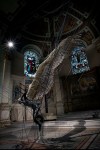
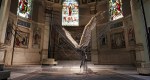
A wax sculpture at the Holy Trinity Church Marlebone, Westminster depicting the devil snared in a set of power lines. The statue is equal parts grotesque and beautiful, showing Lucifer as an oily, black creature with beautiful white wings (created from real feathers).
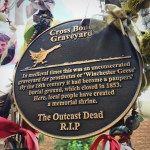
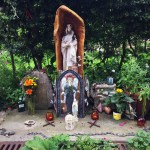
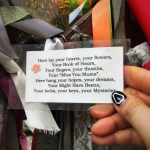
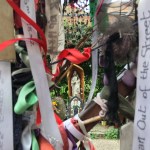
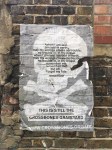
At CrossBones Graveyard, the unconsecrated mass burial ground for sex workers, the poor, and those who took their own lives is now marked by a beautiful garden and lovingly tended to by caretakers who see it as a sacred space. There are also clergy who do regular services of remembrance, regret, and reconciliation to apologize for the wrongs of the church and to honor the dead. There are no headstones here but there are flowers and bees and healing herbs and pilgrims who come from all over to pay their respects to the outcast dead of London.
If you want to visit here I’d recommend the vigil after Apple Day at Borough Market every October, it’s a really moving place.
The Secret and Colourful Life of Folk Catholicism. Part 5. By: Toverij & Spokerij.
That home is. Where the heart is. Has. Always been true. Family is worth. Protecting. Saintly dead. They are Family. Through utterance, with the. Light. of candles. Lit by a worried. Grandmother. Grandfather. Mother. Father. Every Sunday.
Or whispered heart-cries, just before bed. Or sighed, during. Kept. Clean and Pure. Every Sunday, or before. Loving words Faithful listeners. Powerful intercessors. Patrons.
More eyes than just. From the Saintly dead. Ancestors, friends, Who wish us well. Who need our prayers. All in. All. Better to prevent. Than to. Wait. Till something Bad. Happens. Here where. Disaster. Can be adverted. And. Luck. Drawn in.
A house. Is never really. Empty. When it. is. a. Family home.
Its funny that as gay Christians we have to go through gymnastics to try to prove that God loves and accepts us, that our love is blessed and our bodies uncursed, when if you go back to the Didache and other Christian writings from the earliest, apostolic age, you find a lot of condemnations of things like magic and astrology but nothing against gay love. Yet no modern, conservative Christians are lobbying their local paper to remove the horoscopes!!
“Well such sinful lifestyles were unknown in those times, or at most very uncommon” dude this was the first century eastern Mediterranean. People wrote so much gay love poetry in this time period that enough survived for us to fill books with today, and the words to describe gay men and lesbians were widely known and available. And yet! And yet none of these words were used to describe sin!!
Early Christians hated magic and astrology because they asserted that God and nothing else has the final say on matters of nature and fate, and had to compete with other ways of understanding the world and its meaning. They were not spending any time antagonizing gay people.
That practice has its roots much later, in the late 4th century context, when the church was 300 years removed from the ministry of Christ and had become a Roman state institution rather than a persecuted underground community of believers. By this period of antiquity the Greco-Roman obsession with masculinity had morphed from the cocksure posture of previous more prosperous years, where sexual assault was valorized as a sign of virility and strength (Im not a big fan of greco-roman culture tbh), to the tropes more common of a time when authority is in crisis, when all the powerful men become fixated on preserving their power by 1) not cumming and 2) beating homosexuals – sound familiar?
In that context, the later church fathers who were beholden to temporal power structures and educated by these customs authored the first condemnations of homosexuality in Christian doctrine, and not without some controversy.
Spiritual authorities based farther away fron the centers of power in Rome and Constantinople remained ambivalent toward homosexuality, and when the Roman empire collapsed and the middle ages began there was a period of general permissiveness toward gays including the inauguration of “brother-making” and “sister-making” ceremonies that bonded two people of the same sex together for life and allowed them to jointly own property and raise children. This ended with the renaissance, however, and the gradual return of (late) greco-roman law and philosophy prompted a return to the old condemnation of homosexuality.










 bennu rising