
Shlom Lech Maryam
The Ave Maria in Syriac-Aramaic, the language spoken in the Holy Land when Jesus lived on earth. It is sung by Magda Al Roomy.
Category: Uncategorized
heru-wer believes in you

Sorry I’m new to witchcraft but what is bilocation and how do you do it?
Here is how I define bilocation:
A mental process by which you find yourself to be in two places at once. Your awareness is split between the physical world and the spiritual world or the astral.
It is a bit like having a very vivid or unusual daydream that has rules you do not control.
How do you know you’re bilocating? Burn energy. Do something that requires magical energy like casting spells, flying, or breathing underwater. If this tires you, then you are probably really bilocating. If you do not find yourself to be tiring even after much adventure, you are probably not bilocating.
Here is how I bilocate:
I try to become relaxed and enter a semi-tranced state. With a lot of practice this becomes relatively easy. If you’re just starting out, try to daydream! Think about what situations you are usually in when you start daydreaming. Try to replicate those conditions. I found out, years later, that I had been using Spider Solitaire to put myself in to deep trance states for years. I would play this game, zonker out, and go in deep. Find what really “trances you out” and give it a whirl 🙂
When you are in the right headspace to focus, imagine a door in front of you. It is a highly magical door which only you can open. Even though only you can open it you ALWAYS lock it and close it behind you, every time. Alwayssss pls remember always. Ok.
Imagine the door and imagine where you would like to go. Go for a place known to you here on earth, for example a famous forest or ocean or mountain. Tell the door where you want to go; it is a magical door and can hear your commands. When you sense the door is ready (mine moves and pops a bit), open the door and step through. Close and lock the door behind you. Now you are in the astral, bilocating ^_^ Stay safe!
When you are done, go back through the door. Close and lock it behind you. You can easily summon this door to you wherever you are in the astral just by thinking about it.
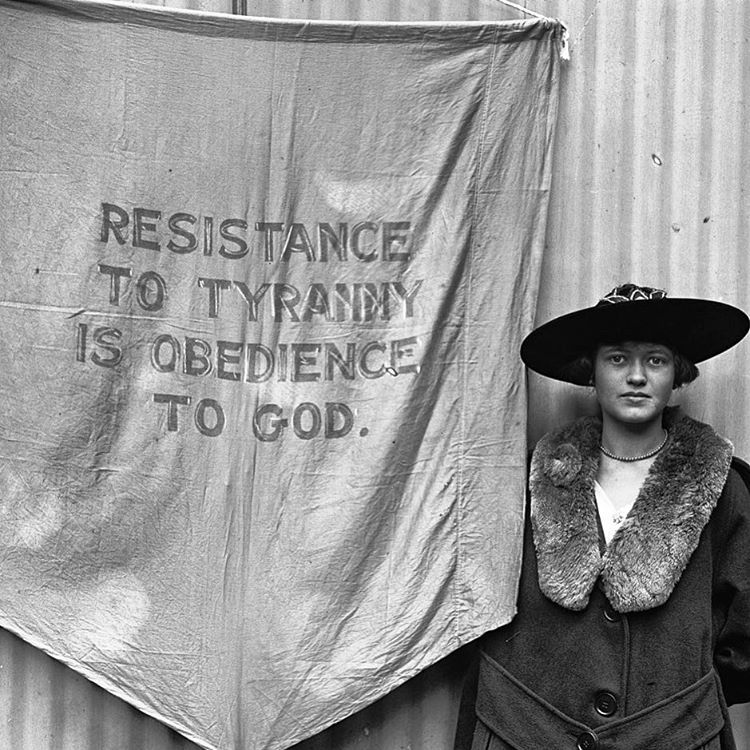
“RESISTANCE TO TYRANNY IS OBEDIENCE TO GOD.,” suffrage activist, Washington, D.C., c. 1917. Photo c/o @librarycongress. #HavePrideInHistory #WomensMarch #Sunday (at Washington, District of Columbia)
I don’t think I could ever NOT reblog this one.
Morning Prayer to Netjer
iiwy em hotep
iiwy em hotep
Netjer, come in peace
I welcome You with open arms
To this day and to this new beginning
I welcome your blessings of peace upon this zep-tepi.
My heart is Your home, may you dwell within it in serenity.
May the Netjeru be pleased and smile upon Their children.
iiwy em hotep
iiwy em hotep
I’ve been wanting a short morning ritual to perform because I don’t usually have the spoons or time to do senut daily or in the morning. (When I do senut, it’s usually in the evening.) So I made one up! I thought it might be useful to share, since I’m sure people are in the same boat as me here.
Mini Morning Ritual
Do you usual morning routine if you have one.
Come before your altar/shrine and offer henu/bow/make a respectful gesture. Say hello/good morning!
Refill or empty water bowls and offering containers as needed.
Offer another bow/henu gesture.
Light incense if you have any.
Recite the Morning Prayer to Netjer.
Offer henu again.
Remove the foot as you leave (Walk backwards a few steps from the shrine and move your foot in a sweeping motion, then walk up again. Compare to closing a circle, it signals completion.), and remember not to leave your incense burning unattended!
Hey so do you have any ideas for a spell to shame someone for shitty things that they either have already done or are planning to do? Like something that will make them realize just how shitty they acted?
like a curse?
Place a sigil of ‘truth’ on the back of a small mirror. Flash it at the person’s image (in person, photos, etc) to bring the dread.
Also, because it’s REALLY fun
Draw the same sigil on your palm, in some stark, startling color and style.
Lift your hand in a lazy greeting to them with absolutely no expression on your face, being sure they saw the sigil. Then go wash it off. Be sure no cameras or other people saw you.
I’ve done it twice. They get the absolute heebie jeebies if you do it right, and if no one else saw and you washed it completely off…then they look even twice the fool. They can SAY you washed it, but people will start to doubt if you say-
“I don’t know what she’s talking about. Maybe someone else told her they saw it, and she’s just….passing it on. You know she likes to do that sometimes.”
Then just shrug amicably and walk away.
ohoho
Possible Biblical view of gender
Okay so I was reading Genesis 1-3 today trying to study what the Bible says about Gender and I found something interesting. In Gen. 1 God makes Man (Gender neutral/mortal) and makes them (they/them) male and female. But only in Chpt. 2 does God make the first female. So did God make Adam’s soul both male and female? To go even further, does this mean all our souls are either both genders or have no genders? If this is true then it would completely explain people having different genders, because they would be feeling the gender of their soul rather than their biological one.
This could mean that while we have gender roles set up on us from the fall that are biology specific, we are still different genders in our soul.
What do you think? Am I reading too much into it or missing something?
Submitted by @adopeydreamer
I think that’s definitely a possibility! The website Hope Remains goes into that, too, saying that both Adam and Eve were gender neutral while inside the Garden because it was only outside that they needed a physical reproductive system/to be biologically different. So I think there’s definitely something to that!
–Admin Emily
It’s basically Gen 1-3 and more specifically Gen 1:27 that brought me to the realisation that I’m genderqueer. It was the earth shattering realisation that “male *and* female he created them” (Gen 1:27) could be read that humanity as a whole was created a mixture of male and female and that the infinite variety that God loves was in that. I realised that God could love me with a gender identity that lay outside the binary, in fact that it’s possible that this was part of God’s original plan for humanity.
You *can* even go one step further and suggest that the whole Gen 2-3 Fall Narrative actually explains that gender is a result of or the cause of sin. It is only after the fall that gender becomes concrete.Oooh I love where this is going! but I’m going to throw the original Hebrew text into the conversation to help clarify and enrich it.
Then, as the second half of this post, I want to add a little more about how I interpret gender in Genesis 2 – so if you want to skip the linguistics, read the summary paragraph below and then skip to the paragraph that begins “As a sort of summary” near the end in bold. You could also skim while focusing on the parts in bold if you don’t have time to read the whole post.
As a summary of what the Hebrew will reveal: those verses in Genesis 1 are not talking about Adam alone – they’re about the whole of humanity, or all of the first humans. Genesis 1 and 2 are actually two separate stories – offering us two versions of Creation. Genesis 1 is a broader picture of how God made all of Creation, and so the making of humanity in this version is just a short overview. Genesis 2 “rewinds” in order to narrow the scope and focus on the making of humans, and so we get more details to the story. (For more on the differences between chapters 1 and 2, see this webpage.)
Thus, when Genesis 1 talks about God creating “man” in God’s own image (and the following paragraphs are going to critique that translation “man”), it’s talking not just about Adam but about all of the first of humanity – or, to relate it to Genesis 2, to Adam and Eve.Some of this discussion is going to get a little linguistic-y and grammatical, so if there’s a part you don’t understand, don’t freak out! I’ve done my best to be as clear as possible, but feel free to ask questions, or to simply shrug and move past particularly confusing sentences; even without some of the details, you should get the big picture.
Let’s dive in.
I recommend pulling up this webpage, which is an interlinear version of Genesis 1, to look at while reading this info on the Hebrew. The main verses relevant to this discussion are Genesis 1:26-28, so scroll the page down to there.
An interlinear text lines up the original Hebrew with a (very literal, basic) English translation, word for word. Note that you have to read the English lines from right to left, as that’s the order Hebrew goes in! It also follows the Hebrew word order, so you have to sort of flip flop some of the English for it to make sense.I am going to go verse by verse, pointing out the words that are important to the conversation and that may not always be translated clearly from the Hebrew into English.
Verse 26: “And God said, let us make adam in our image, according to our likeness; and let them have dominion over the fish of the sea and over the birds of the air…(etc.)”
- First off, let me clarify the Hebrew word adam before translating it into English. Here, it is not talking about the first man whose story is told in Genesis 2 whose name is Adam – while this word can indeed be a name, it is more often used as a common noun in Hebrew for humans in general. (On a complete tangent, if you’re curious, here’s a post I wrote months ago that discusses the differences between the word adam and the word ish, which is the word for “man” specifically.)
- adam – as OP notes, the word used here is indeed gender neutral in the original Hebrew, despite often being translated into English as “man.” Clines’ dictionary defines adam as being able to be a collective noun (basically, a noun that “looks” singular but represents a plural group, such as the word “class,” which is a singular word representing a group of students) or a singular noun. Here is its definition of this word:
– “1. humanity, human beings, people, persons in general (without regard to sex); human race as a whole.”
– “2. individual, human being, person, whether a particular person or a typical human.”
So here in verse 26, when God makes adam in God’s image, is adam one human being (no gender specified) or humanity as a whole? I would say the second option – this verse is saying that God makes the whole human race in God’s image.- “…let them have dominion…” – this phrase is in the Hebrew one word, a verb – one that has a plural ending on it. This is not being used as a singular indefinite pronoun the way “they/them” can be used in English, because that cannot be done with this Hebrew construction – it is indeed referring to multiple people. So, combined with adam, we can surmise that “let them have dominion” means “let all human beings have dominion.”
Verse 27: “And God created the human race in his own image; in the image of God he created them; male and female he created them.”
- Here is where stuff gets good.
- You will notice that in my above English translation, them occurs twice – but in the actual Hebrew, there are two different pronouns being used.
- “in the image of God he created them” – here the pronoun is in the masculine singular, and is usually translated “him” or “it,” as it is used to refer to male individuals as well as nouns that are masculine (Hebrew has gendered nouns the way, say, Spanish does). In this verse, the masculine singular is referring to “the human race,” as adam as a noun is technically masculine (the “default” gender of Hebrew), even though it refers to people in a gender non-specific way, if that makes sense. So in some translations you’ll see it translated “he created him” to be true to the singular-ness of the Hebrew pronoun – but that causes confusion, making the reader think the verse is about one man, rather than the human race.
- “male and female he created them” – here the pronoun is indeed the masculine (or default; it can encompass individuals of any gender) plural. Like the phrase “let them have dominion” in verse 26, this use of the plural pronoun clarifies that the adam God is making in God’s image is indeed plural – not just one human but humanity.
- “male and female he created them” – oh no, you might be thinking, if this passage is thus about all humanity and not just Adam, does that mean that God makes all humanity male and female – i.e., with no possibility of humans being non-binary genders? Indeed, this verse is all too often used against nonbinary folks (and trans folks in general) in this way. But fear not.
- People have written about how this and is “not a binary and” – just as God creating the heavens and the earth encompasses all that is in them, so God creating humans male and female encompasses the rest of the gender spectrum – see this short post, as well as this video by Austen Hartke for a more in-depth look at this idea (starting around 2 minutes in). As Austen explains in the vid, things in nature are not so easily categorized into the binary “and”s of Genesis 1 – “if day and night were so equally separated, we wouldn’t have dawn or dusk.”
Verse 28: “And God blessed them and God said to them, ‘Be fruitful and multiply and replenish the earth and subdue it, and have dominion over the fish of the sea and over the birds of the air…”
- Not much new to note for this verse except to confirm that all of uses of them here are indeed plural, speaking to multiple beings; and that the command forms here are also plural – God is making the commands not to one person but multiple. This is cool to note when it comes to equality of genders – not only men receive God’s blessing, and not only men are told to “have dominion” – the first humans together are told this. (The verbs and pronouns in verse 29 are also all plural.)
So that ends the discussion of the Hebrew for Genesis 1:26-28. But even with all of that information, I’m intrigued by some of your points, @adopeydreamer and @gqsnail! Even though Genesis 1 is discussing the creation of all the human race (or, if you prefer, of both Adam and Eve, the first two humans), I think you could indeed interpret that line “male and female he created them” as stating that each individual human is “male and female” – that we each are created with the potential to be male, or female, or both, or something that fits elsewhere on the spectrum signified by that conjunction and. That’s pretty rad, and I’ll bring it up again a little later on.
Beyond that, I definitely recommend, as gqsnail does, checking out what hoperemains has to say about Adam and Eve. There are some things the webpage says that I’m not sure I agree with fully, but it’s a wonderful start at considering these first humans and gender and sexuality. It also clarifies some stuff about how Genesis 1 is an overview while Genesis 2 is more specific, and explains Hebrew nouns a bit, so if you found what I wrote confusing, see if the link helps you make better sense of it.
That leads, finally, to what I want to contribute to the conversation – not about Genesis 1′s version of creation, but the different version offered in Genesis 2:
Hoperemains points out that while adam – the basic, non-gender-specific word for “human” (which is often inaccurately translated as “man” in English Bibles) – is what God forms out of the dust in verse 7 of the Genesis 2 story, this adam actually uses a different word for himself – ish, the gender-specific word for man, i.e. a male person.
In other words, God created a human being without specifying a gender for that human being – it is this adam who chooses to label himself ish, to identify as a man. He first does this in 2:23, after calling the human formed from his rib ishah, the word for woman.
The fact that the man is the one who labels the woman leaves me feeling conflicted – it would be much “better” if she were able to choose for herself what she was instead of the man choosing for her (he also picks out her name, Eve, in 3:20); but if one studies the way social binaries are constructed, it is true that the dominant member of the binary tends to be the one that imposes the “lesser” label onto the oppressed member of the binary, so…from a sociological view, this makes sense. (It’s also a matter of recognizing that I’m likely reading way too much into it – I prefer interpreting scripture while keeping its very human, patriarchy-influenced authors in mind.) But anyway, I thought I’d throw this out here as kind of cool – that the first human chooses their gender.
As a sort of summary of all of this; If we want to read Genesis 1 and 2 together, we might read it thus:
- In Genesis 1:27, God creates the human race male and female – we can read this as each human being thus being created with an innate capacity to be male, female, and/or somewhere on the spectrum hidden in that word and, as formerly discussed. Even so, the text continues to use the neutral adam in 1:28 through the majority of chapter 2 – God does not label any individual adam as an ish or an ishah, a man or a woman.
- In Genesis 2, which “rewinds” and offers a more detailed account of humanity’s creation, God forms the non-gender-specific adam out of clay and spirit and then forms a “helpmate” (an interesting, also non-gender-specific word discussed more in the above hoperemains link) from that adam’s rib. Only at that point do gender specific terms enter the story – not from God, but from the adam, who identifies himself as ish, a man, and labels his helpmate ishah, a woman.
With these two chapters together, we have space to view gender as something God created, or as a social construct, or as a mix of the two. From Genesis 1, we see God making humans with gender (or at least sex) specified for the spectrum of humanity but without specifying a gender for any one human. From Genesis 2, we see God making humans with no genders (or sexes) specified, and the adam choosing to identify himself with a specific gender.
Why does this matter? Because it honors both those who hold their gender as something important to them and their faith, as well as those who don’t identify with any gender or who have struggled with being gendered in certain ways against their will. We can honor gender as something God created a potential for in each human being, while also honoring the agency each human has to choose their own gender.
We also see in Genesis 2 the act of Adam gendering Eve, rather than Eve choosing to identify as a woman for herself. This is something we certainly see reflected in the history of the gender binary, with very harmful consequences over the ages.
So rather than gendering one another, let us offer to each individual person the agency God created us with – to choose for ourselves how we want to identify, to feel out for ourselves which gender (or genders, or no gender at all) speaks to us from within the common human roots inside ourselves.
Thanks to @adopeydreamer, @lgbt-christian-safe-haven, and @gqsnail for starting this conversation! Sorry I wrote so long haha, but you’ve gotten me to look deeper into these first chapters of Genesis and I’m excited about that. I’d love to hear anyone else’s responses!
This is very thought provoking and much appreciated! Thanks for that research as well!


Chiesa dei Morti, or the Church of the Dead, is a tiny church – and the main attraction – in Urbania, a lively medieval town located in central Italy. In the cemetery, eighteen mummies are standing in individual glass cases that have been on display behind the altar since 1833. These corpses have been naturally mummified by the presence of a special mold that sucked all of the moisture out of the bodies
21 Day Kemetic Challenge!
Hello and welcome to the 21 day Kemetic Challenge! Feel free to do as much or as little of it as you wish! And if any questions don’t quite apply to you, you can always answer them hypothetically and say what you would do if it did apply! Most importantly though, have fun!
Day 1: What drew you to kemeticism? When did you realize that it was for you?
Day 2: Are you a reconstructionist, revivalist, or more modern kemetic, and why?
Day 3: Are you practicing independently or with a group or community? Why did you choose this? Do you think it would ever change?
Day 4: Which gods are you devoted to or worship? And which other ones are you interested in in any way?
Day 5: How do you communicate with your gods? Can you hear their voices in your head as thoughts, do you get feelings or emotions, or anything else?
Day 6: Talk about your relationships with your gods. How do you build these relationships? What are they like to you?
Day 7: What kinds of things do you offer to your gods? What do they like? Do you give universal offerings, or something for each one separately?
Day 8: Are there any activities that you devote to your gods?
Day 9: Do you devote music or playlists to your gods? What kind of music do you play for them?
Day 10: Are there any gods you work with or talk to that you’re not devoted to or worship?
Day 11: Talk about your shrine. Is it digital or physical, or both? What kinds of things are on it? Do you make any of it yourself?
Day 12: Have you set up any other devotional items or spaces around your room or house?
Day 13: Are there any jewelry or objects you wear or carry?
Day 14: Do you own any kemetic or egyptian books? Are they digital or physical or both?
Day 15: How important to you is correct terminology?
Day 16: Are there any rituals that you regularly perform?
Day 17: Do you honor your ancestors or the dead in general, or no?
Day 18: Are there any holidays you celebrate? Which ones?
Day 19: Do you use heka in any way? How do you utilize it?
Day 20: Do you keep a journal for your journey and experiences?
Day 21: And to top it all off with a bang, how do you live in Ma’at? What kinds of things do you do or say or believe that help you with this? Talk a little about your lifestyle and what you do to live in Ma’at.
And that’s it! Thanks for participating!
 bennu rising