
the guy next to me is ranting about our local Overly Commercialized Church tm, and maaan do i want to get involved in this conversation
Category: Uncategorized

“THE LORD IS MY SHEPHERD AND KNOWS I’M GAY,” National March on Washington for Lesbian and Gay Rights, Washington, D.C., October 14, 1979. Photo © Ted Sahl. #lgbthistory #lgbtherstory #lgbttheirstory #lgbtpride #QueerHistoryMatters #HavePrideInHistory #TedSahl #Sunday
(at Washington, District of Columbia)

God is no stranger to pain. When you cry to Him, He isn’t looking down on you and saying, “Here we go again.” He’s leaning down, feeling every tear of betrayal, anxiety, and grief that you are crying, and saying “I know. I remember. I know.”
I really love this.
saw this on my dash, felt the need to reblog it again.
this is like sooo dumb but i’m confused about the difference between evangelical vs mainline protestantism and how that fits into protestant denominations like methodist or baptist
It’s not a dumb question at all. A lot of people try to define the line between evangelical and mainline, but I believe it is more like a spectrum. This is probably my favorite article on the issue.
I am going to explain John Green’s theory of Evangelicalism (and no… not that John Green):
Most Evangelical churches have these four beliefs.
- The Bible is infallible and literal. The Bible is the Word of God and is not to be disputed. That it provides the absolute and only truth.
- Salvation is only through Jesus Christ, all other religions are inherently false.
- Individuals must accept salvation themselves, and must be “Born Again.”
- Evangelism is necessary in order to “save” the world.
Mainline Protestants are different from Evangelical churches in these four ways:
- The Bible is a very spiritual document, and it does contain within it the words of God. But there is room for historical and cultural context.
- Salvation is through Jesus Christ, however, Jesus Christ isn’t necessarily the only way to salvation.
- Protestants aren’t concerned with personal conversion, however they do have “spiritual transformations” which they go through different stages of life.
- Not necessarily anti-proselytizing, but they aren’t obsessed with it. Sharing the “Good News” is not just telling everyone about Jesus, but rather should be focused around charity.
Now these distinctions can get blurry at times, that’s why I call it a spectrum. Some churches lean toward Evangelical, but have Mainline aspects and vice versa. Fitting this into denominations gets difficult because not every part of the denomination is one way or the other. There are always exceptions.
The most common mainline Protestant Churches are called the “Seven Sisters of American Protestantism” (The United Methodist Church would be a part of it). The most common Evangelical churches tend to be Baptist, Holiness, Pentecostal, Reformed, and nondenominational. These are generalizations and not necessarily true 100% the time.
Magick, my friend
Tattoo artist: Do you take some kind of pain suppressant before coming in?
Me: No. Why?
TA: Because this piece has taken a total of nearly nine hours and you never move.
Me: (That’s cause: Magick, my friend.)
Skin be steel flesh be stone
Nerves be strong, as gem or bone
Let pain be but kisses, or breaths of air
Magic be my armour, for i will not bear
Neither the sufferings of the dead or the agonies of hell
Runes of blood, now serve me well
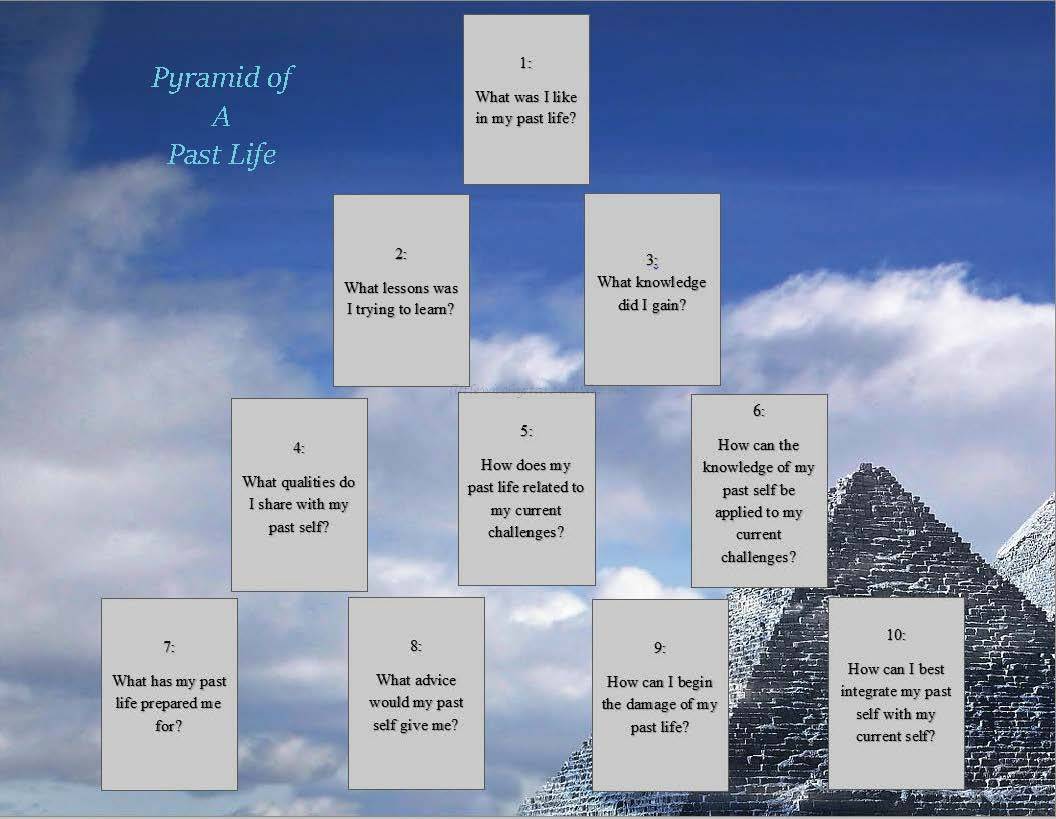
Pyramid of a Past Life
This 10 card spread is designed to look at one of your past lives and determine it’s relationship to your current life.
Card 1: What was I like in my past life?
Card 2: What lessons was I trying to learn?
Card 3: What knowledge did I gain?
Card 4: What qualities do I share with my past self?
Card 5: How does my past life relate to my current challenges?
Card 6: How can the knowledge of my past self be applied to my current life?
Card 7: What has my past life prepared me for?
card 8: What advice would my past self give me?
Card 9: How can I begin to heal the damage of a past life?
Card 10: How can i best integrate my past self with my current self?This is the very first spread that I am sharing. If you use it I’d love to see your results so tag me! Please don’t repost and please give credit if used. Thanks!
If you are interested in receiving this reading please message me.
But Christ did not die for the good and beautiful. It is easy enough to die for the good and beautiful; the hard thing is to die for the miserable and corrupt[…]
Shūsaku Endō, Silence
(via gildedmouths)
(via gildedmouths)
It’s important to remember that the word ‘Lent’ itself comes from the old English word for ‘spring’. It’s not about feeling gloomy for forty days; it’s not about making yourself miserable for forty days; it’s not even about giving things up for forty days. Lent is springtime. It’s preparing for that great climax of springtime which is Easter—new life bursting through death. And as we prepare ourselves for Easter during these days, by prayer and by self-denial, what motivates us and what fills the horizon is not self-denial as an end in itself but trying to sweep and clean the room of our own minds and hearts so that the new life really may have room to come in and take over and transform us at Easter.
Rowan Williams (via mackjao)
 bennu rising