

a rough rough concept of Gospel of Mary prayer beads
A list of single-word incantations, spells that can be cast merely by saying/thinking them with intent, or over a white candle.
☄ Cuisolas
From irish, Cuisle and Solas, pulse and light
For a source of light give you strength☄ Astripta
From latin, Astra and Scripta, star-written
Written in the stars, to tie something to fate.☄ Solicolmére
From latin, salis, salt, and french, mer et colére, sea and anger
From salt to sea salt, anger disapates like sea foam☄ Sucétoiles
From french, Sucre et étoiles, sugar and stars
To enchant light with the power to soften sweeten.☄ Rosetaltion
From english, rose, nostalgia and elation, feelings for the past and happiness.
To give memories rose colored glasses.
So, in my searching for more Christopagan and Green Christian sources, I stumbled upon a blog that had the most beautiful thing, entitled the Rune of Sophia.
God is Love, (1 John 4:8)
and Her Body is All Creation. (Col 1:15-20)
She is a Tree of Life (Proverbs 3:18)
Who gathers Her children in Love. (Luke 15:3-10)
Absolutely beautiful.
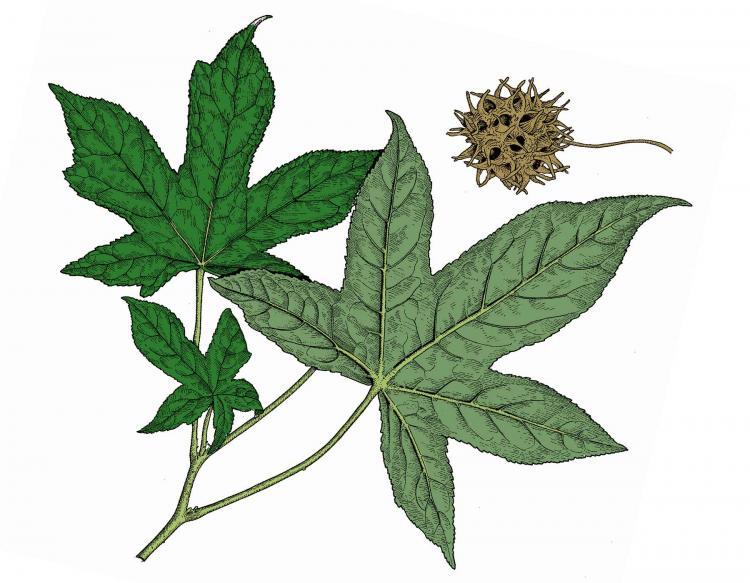
Plant magic: Sweetgum.
- Dried seedpods, commonly refered to as Witches’ Balls, Witches’ Burrs, and Sticker Balls, are protective and can be “loaded” by sprinkling herbs into the holes and then sealing with wax for warding. The dried seedpods can also be placed on windowsills or in corners of the home to act as protective elements to set or reinforce wards. The pods can also be used in witches bottles to protect the home and prevent theft. Witches’ burrs can also be used for commanding and compelling. A photo of the target or a name paper can be wrapped around the spikes of the seedpod, intended to cause them anguish until they complete commands. Burrs can also be added to hex jars.
- Leaves. Sweetgum leaves are shaped like stars and can be pressed and used for bookmarks. They’re protective and can be used like bayleaves in spells: inscribe something on the leaf and burn it to assist manifestation.
- Gum Resin. The resin the tree exudes, called Stryax Resin, can be used much like benzoin. If you can find a tree with globs of hardened sap from past injuries it can be saved and used as purification incense or as an offering. The gum is known to have a sweet taste and is mildly anti inflammatory. Can be added to washes, colognes and mixtures to provide protection, especially from spirits, healing, or luck.
Theism: belief in and worship of god(s).
Monotheism: belief in and worship of only one god.
Polytheism: belief in and worship of many gods.
Megatheism: belief that there are multiple gods, but that yours is superior to all others and only They are worthy of worship.
Henotheism: worship of only one god while acknowledging (the possibility of) the existence of others.
Kethenotheism: the worship of only one god at a time.
Monolatrism: the worship of only one god while believing in multiple gods.
Pantheism: belief that the divine is in everything.
Panentheism: belief that the divine is in everything, while also being beyond everything.
Apatheism: being neutral towards the possibility of the existence of god(s).
Atheism: neither believing in nor worshiping god(s).
Antitheism: being actively opposed to the belief in and/or worship of god(s).
Transtheism: a belief system that cannot be easily categorised as either theistic or atheistic.
(Sadly, not the belief that god(s) is/are trans or that trans people are god(s)).Autotheism: belief that divinity is inherently within oneself (may or may not exclude external divinity).
Agnosticism: belief/philosophical position that the divine (and/or whether or not it exists) is unknowable.
Ignosticism: belief/philosophical position that knowledge regarding whether or not god(s) exist is unprofitable.
Deism: belief/philosophical position that God does not interfere directly with the world.
Pandeism: belief that the creator deity became the universe and then ceased to exist as a separate and conscious entity.
Monism: a philosophical position that attributes oneness or singleness to existence.
Dualism: a philosophical doctrine that attributes co-eternal binary opposition to existence.
Omnism: the recognition and respect of all religions.
Panpsychism: belief/philosophical position that consciousness, mind or soul is an intrinsic universal attribute within all things.
Ietism: unspecified belief in an undetermined transcendent force.
Omnibenevolence/eutheism: belief that (a) god is wholly good.
Dystheism: belief that (a) god is not wholly good and may be evil.
Maltheism: belief that (a) god is wholly evil.
(Please correct any false definitions or add new ones to the list.)
A very interesting list. Don’t forget to check the notes for other terms and definition as well.
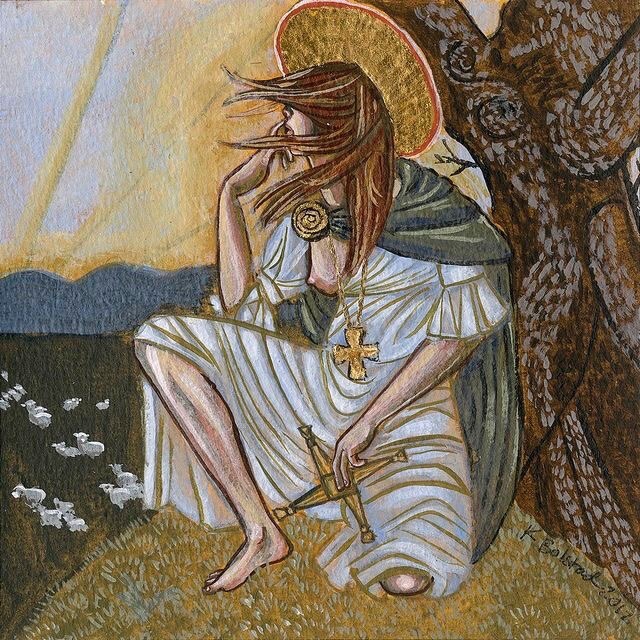
St. Brigid Inside the Icon Box
By Karin Bolstad
2012
@ religious head covering anon, from Mod Evodije (long reply under the cut):
(I don’t want to reply directly to your ask since your question seems to be more directed at our Muslim mods, and I do not want to speak over them by stealing your ask out of the inbox with a direct reply.)
from my experiences, progressives are cool with religion so long as religious people never mention or show outward signs of their religion. ever.
I feel like I should clarify and say this is very much a white progressive attitude.
A quick note: Please don’t send me asks relating to weather magic. It is an interest of mine but I am not comfortable teaching others yet. I’ll link some helpful blogs at the bottom!
To bring…..
Sun:
Warmth:
Rain:
- Rain summoning spell
- Rain summoning spell jar
- Rain calling chant
- Rain-bringing chant
- To bring rain to a region
- Heavy rain spell
- Quick and easy rain spell
Cold:
Snow:
- A spell for snow
- Chant to draw snow to you
- Holiday ornament snow spell
- Make it snow spell
- Snow spell
- Snow spell
Clouds and Fog:
Wind:
A storm:
- Thunderstorm spell
- Long distance storm calling
- “Song of storms” enchantment
- Spell to bring up a storm
- Storm calling incantation
- Summon a storm spell
To Banish:
- Spell to weaken a hurricane
- Charm to seal up a storm
- To lessen a storm
- Protective storm ward
- Spell to ward off rain
- Untie the wind
- “Fuck off hot weather” spell bottle
Other:
- A collection of spells + sigils
- This post with even more spell links and resources for beginning weather magic
- Some tips + Part two
Helpful blogs:
“the Bible says homosexuality is a sin” well the Bible also has a lot of sexism, rape, incest, violence and a lot of contradictory messages in general because it was written by people and people have agendas
I don’t really think that God even has the time to care about if people are gay like if he’s got a whole world to run there are more important things anyway
And if God is love, he’s not just loving me if I am what he wants; he’s loving me as the person he made me to be, which is a queer person
You can’t say “I love you, and I made you gay but I’m sending you to hell you awful sinner” my dude that doesn’t make sense it’s not like hell has a low population is it
The god I believe in loves queer people because that’s how he made us
the bible doesn’t condemn homosexuality anyway. It’s content taken out of context and misinterpreted over hundreds of years of translations, re-translations, and mis-translations.
Hell, in Kenneth Davis’s Don’t Know Much About The Bible, there’s a passage that absolutely blows my mind and proves just how much we can misinterpret with simple translation mistakes:
“In researching the world’s oldest city, for instance, I learned that Joshua’s Jericho is one of the oldest human settlements. It also lies on a major earthquake zone. Could that simple fact of geology have had anything to do with those famous walls tumbling down? Then I discovered that Moses and the tribes of Israel never crossed the Red Sea but escaped from Pharaoh and his chariots across the Sea of Reeds, an uncertain designation which might be one of several Egyptian lakes or a marshy section of the Nile Delta. This mistranslation crept into the Greek Septuagint version and was uncovered by modern scholars with access to old Hebrew manuscripts.”
The bible is one long-ass game of telephone, whispered around the world in dozens if not hundreds of languages, for thousands of years. I have a hard time knowing what my grandpa is talking about, when he starts going on about the technology or practices of his youth, and that was only about 80 years ago, in the same country and in the same language as me. So why every Joe on the streets thinks they can take one or two verses, completely out of context and probably mis-translated several times to boot, and use it to spout propaganda and hatred for an entire group of people will forever be beyond me.
You’re all valid, and frankly, if there is a ‘loving God,’ then that God will be happy to see you happy. Seriously.
I needed that. Thank you.
The Bible wasn’t faxed down from the sky, people, it’s been compiled and formulated for hundreds of years until it became what it is today. And yes, misinterpreted by whoever with whatever agenda-of-the-day.
And hypocrites always stick to the word and not the spirit of any religion: to love, to help, to respect, to protect, and to strive to make the world a better place.
Yup, Jesus never said ANYTHING against LGBT people. All he said was don’t be greedy, don’t be lustful and don’t be wrathful. The fact that LGBTphobes took those instructions out of context to justify their LGBTphobia is pretty telling!
Hey, your friendly neighborhood Jew here!
You guys know that verse in Leviticus that homophobes like to trot out? Well, I’m here to tell you:
They don’t read Hebrew and they don’t know shit.
And now here’s something you probably won’t hear from any of those Fine Christian Folks ™ anytime soon, either:
We do read Hebrew and we still don’t know shit.
Here’s the thing. The most “accurate” word-for-word translation of that verse would say “a man shall not lie with another man; it is forbidden.”
Here’s the issue.
The grammar surrounding “men” in that sentence isn’t correct, and the word I’ve translated as “forbidden” is “toevah,” a word so fucking old we literally don’t know what it meant anymore.
The strange sentence construction suggests that “lie with another man” uses a feminine construction you wouldn’t normally find in a sentence that’s entirely about men, and while “toevah” means “forbidden,” it’s not actually clear what is forbidden. Here’s an incomplete list of possibilities:
Pederasty (adult male/adolescent male sex) is full-stop forbidden, a man sleeping with a male prostitute is full-stop forbidden, a man sleeping with a man as part of any kind of sex magic or fertility ritual is forbidden.
And my rabbi’s personal interpretation, based on the sentence construction: a man shouldn’t sleep with another man in a woman’s bed. (So basically: don’t cheat on your wife with a dude, which is probably treated separately from “don’t commit adultery” because adultery would come with the risk of an illegitimate child.)
You’ll notice none of these involve “ew, you disgusting gays.”
Unless you accept a word-for-word literal translation with zero consideration for the social mores and other tribes surrounding Israel contemporary with the writing of Torah, nothing about this commandment has anything to do with our modern understanding of queer people having committed relationships. Once you start taking the rituals and practices of Israel’s contemporaries into account, it suddenly becomes clear why these prohibitions would have been put into place (sex magic was common in the cult of Ba’al, for example, while pederasty was practically a requirement in Greece).
If you’re just a person out there loving other people of the same gender as you? The Torah says nothing against you. But do you know what our literary tradition does say?
It puts you in the company of Naomi and Ruth.
Ruth is considered the first convert, and her vow to her mother-in-law Naomi (after Ruth’s husband’s death) forms the basis of our modern marriage vows. “Where you go, I shall go, and where you lodge, I shall lodge; your people shall be my people, and your G-d my G-d; and where you die I shall die, and there shall I be buried.” Ruth remarries as prescribed by law at the time, but even when a child is born of that new union, nobody calls it “Ruth’s and Boaz’s child”–they all say a child has been born to Ruth and Naomi.
You are in the company of a woman whose name we invoke in our prayers and whose life we celebrate. I wear her words around my shoulders on my tallit, my sacred prayer shawl. Since we consider that everything in the Tanakh is intended for learning and study, what might we take from this story, but that a queer person can be virtuous and beloved of G-d?
 bennu rising