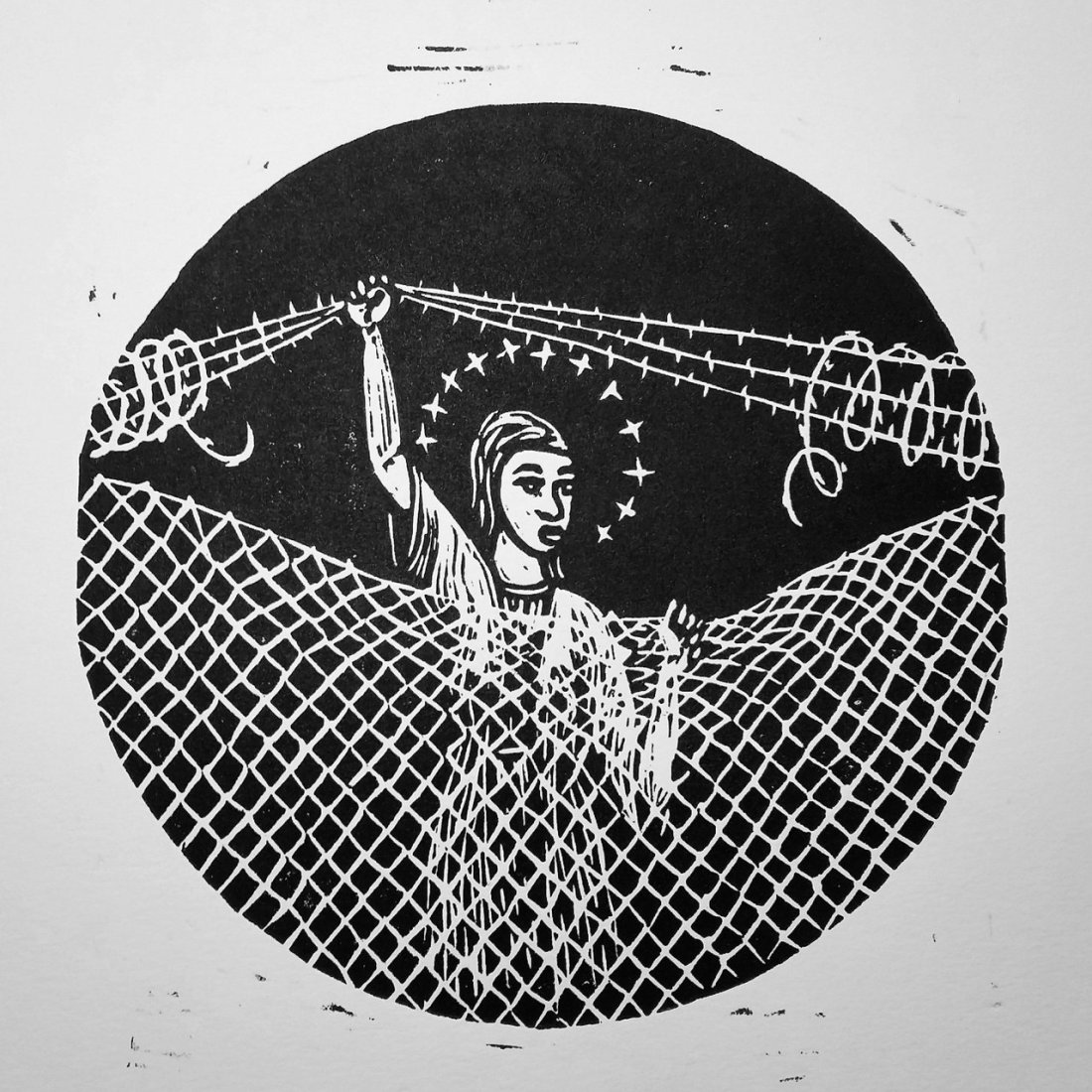
Thinking about how I could make the argument that Christ was a trans woman named Sophia whose deadname was Josh and now I’m like, fuck I would want to date here, which I guess is big John the Apostle feels
Ok so Sophia, or divine wisdom, is essentially the Eastern Orthodox version of what the Western Rite calls the Logos, the Word made flesh in Christ. Kinda. Its complicated, bc some would say divine wisdom is simply one of the gifts of God and not equivalent to the Logos, while others say they are equal but are distinct, locating Sophia not in Christ but in the Holy Spirit or even in Mary, Christ’s mother. From my own studies of early Christian history though I am of the opinion that the Logos and Sophia are two words for the same phenomenon, for the aspect of God we also call God the Son who was incarnate in Christ.
Sophia has appeared to female saints and mystics throughout history as a woman, a feminine aspect of God. This might also explain why some believe the Holy Spirit is Sophia, bc the Holy Spirit is also often understood as feminine. But if Sophia is the Logos, the Word made flesh, then Christ’s true name is Sophia, that is to say, Wisdom, and Christ’s maleness and given name (Yeshua, which in ancient Greek is Jesus but in our English is more appropriately rendered as Josh) were assigned by humanity and not inherent to Christ’s nature.
Add in Christ’s statements on gender. In Paul’s letter to the Galations, one of the oldest Christian documents we still have, he says that there is neither male nor female in the eyes of God. This would have been a radical statement, and indeed our patriarchal society has been doing everything it can to suppress this tenet since that time, so this cannot simply be an inference Paul made “from custom,” as he often does in his letters, but rather was part of the divine wisdom shared with him by Christ on the road to Damascus.
Furthermore, in the Gospel of Thomas and the Gospel of the Egyptians, two ancient scriptures that are not part of canon but are accepted by many modern theologians as genuine witness to Christ’s ministry, Christ speaks directly on the necessity of what we might today call gender abolition.
Interestingly, Thomas and Egyptians, the latter often attributed to Christ’s disciple the woman Salome and the community of believers in Egypt she founded, frame the issue in different ways. Thomas, as a man might be expected to do, frames it as ‘through Christ, women can become like men, and thus improve themselves bc men are of course the superior sex and a perfected humanity would be all men.’ Salome, a woman, instead says that perfected humanity will have neither male nor female! As we might expect, Thomas’ gospel was less controversial and thus more well preserved.
Also I should explain the John the Apostle bit. John has been understood for millenia to be feminine, the Beloved Disciple who is the lover of Christ (there was a substantial tradition in the early church that described Christ’s intimate relations with men) in the Gospel of John, and is often believed to have been intersex.
I dream of a world where we encourage biblical literacy by doing a nativity pageant each year based exclusively on only one of the four Gospels, instead of a mishmash.
Mark: 15 minutes of complete silence in the dark. Everyone is given a tiny scroll that reads, “I will send my messenger ahead of you, who will prepare your way—a voice of one calling in the wilderness, ‘Prepare the way for the Lord, make straight paths for him.’” Suddenly, a very hairy man with bugs on his face jumps down from the rafters screaming, “REPENTTTTTTT!”
Matthew: full scale retellings of each person in the genealogy, including Tamar, Rahab, Ruth, and Bathsheba. (This is the longest one. Parents are upset by their children being assigned any of the women.) Mary is then “found” to be pregnant, Joseph tells the audience that he’s going to divorce her, he falls asleep. An angel harangues him in his dreams. He doesn’t divorce her, and takes her home kind of crankily. They have a baby. Some Magi come ask the despot ruler about a powerful baby just born. Herod freaks out and consults all his spies. The Magi head out again, find the baby, worship him, and avoid Herod on the way home. An angel comes back to harass Joseph while he sleeps, telling him to run for his life, because Herod is *pissed.* They make it to Egypt.
All boy children under 2 are graphically murdered (blood packets everywhere), lay all over the space, spattered with red.
Women scream for a long time.
An angel tells Joseph in a dream that it’s safe again, and they go back – but only to Nazareth, because it still isn’t safe everywhere. The end.
Luke: The living embodiment of the “Well, actually…” guy comes to the front to tell you that you may have heard about Jesus, but it was all pretty wrong, and HE is here to set you right, and aren’t you grateful he’s so good at it? Then an old priest starts presiding at the altar, as you do, with pots of incense burning. An angel – covered in wings and eyes – pops out beside him. The old priest freaks out. The angel drones, “Your…wife…will…become…pregnant…your…wife…willl.become…pregnant…” The priest looks blank and says, “Yeah, I don’t think that can happen. We’re old.” The angel rolls their many eyes, places eight hands over the priest’s mouth, and says, “You. You’re not allowed to talk anymore.” The priest walks out of the sanctuary and everyone is worried about him, but he can’t tell them what happened.
His wife gets pregnant and hides in the church closet for the play-version of five months.
Following that, pretty much every Nativity play we already do, minus the Magi and the star. The old priest gets to talk again once his kid gets circumcised, and then he sings a long song about how it was good he was wrong.
John: The room is dark. Tiny children wear black capes. They whoosh around the room whispering, “in the beginning…in the beginning…in the beginning.” One of them whirls around to display a glow in the dark WORD, and they dance over to another child, whose belly reads GOD, and then they link and become one unit, together, dancing, dancing. They keep pulling out glow in the dark scarves that say light light light, and they dance around lighting all the candles scattered throughout the room.
They chant, “the darkness did not overcome us! Ha!”
A haggard man enters the room and says, “I am a witness to all this light.”
The children whisper, “the true light is coming, the true light is coming, the true light is coming.”
[from the loudspeaker: “The true light is coming! To the world! Even though he came to the world, and made the world, the world didn’t like him much! He came to his own people, who rejected him, probably like some of you! But those who did recognize him, and you sitting here, if you’re ready, will become children of God yourselves! Not some halfway “actually children of people who feel slightly more divine because of church” nonsense! Actual! Children! Of! God!“]
The child bearing the word WORD tears off their cape and runs around in their underwear, in the flesh, like a wild thing.
________ Note: none of these sets contain stables.
I think that “O come, O come, Emmanuel” is antisemitic in the same sense that the New Testament is at times antisemitic. It projects Jesus as the Jewish messiah and as the savior of Israel, which in it’s own sense perpetuates the antisemitic idea that Jewish people need to accept Jesus. I don’t necessarily think that we should ban “O come, O come, Emmanuel” however that we should be critical of it’s lyrics.
One of my seminary profs with a strong interest in Jewish/Christian relations shared these alternate lyrics to the song. They shift the perspective away from the supercessionist vision of “incomplete israel” and include more positive references to God’s saving actions in the Hebrew Bible/Old Testament. First verse and refrain below:
“The gods neither know nor understand, wandering about in darkness, and all the world’s foundations shake. I declare, ‘Gods though you be, offspring of the Most High all of you, Yet like any mortal you shall die; like any prince you shall fall.’ Arise, O God, judge the earth, for yours are all the nations.”


 bennu rising